Wednesday, January 17, 2007

William Topaz MacGonagall


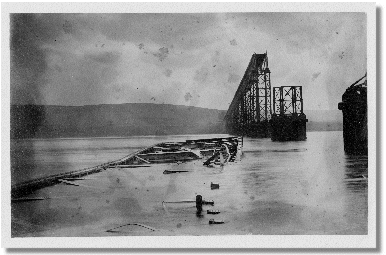
A long time ago I used to write poetry. None of it remarkable, most of it not very good. There were no Tay Bridge Disasters in the lot, but needless to say, I was no Keats. I lacked the patience and discipline to write when there was no visceral prompt, no muse whispering in my ear. And on those occasions when Calliope did descend and move me to commit my verses to paper, I was too lazy to go back and properly revise and refine the words that earlier poured from my pen like so much water from a fountain. For example, I wouldn’t take the time to go back and remove awkward and unnecessary similes, like so much garbage from the roadside. So even though I still write with some degree of frequency, I stay away from the poems.

Earlier this week however, I discovered, while organizing My Documents, a poem I had toyed with while working as a Data Reporting Specialist. On one of my lunch breaks, presumably during some early-infant sleep-deprived haze, since I don’t really remember ever composing it, I took a phrase from an email my mother wrote. The communiqué involved some familial medical difficulties that at the time were rather dire, but from which my relative recovered successfully. I took some liberties and made up my own story based on the letter. It’s all totally fictional. I just loved the deceptive exposition of my mother’s introductory line, and so used the same line to start this poem. Perhaps with this poem, I will set my sights and really whittle it down to its essence. Or expand it, who knows? Perhaps, I’ll just let it lay the way it spilled onto the page. Either way, I don’t think it’s terrible.

Things I’ve Learned

Sweetie-
things I've learned;
Autumn is actually a woman about our age,
53, whose son just graduated
high school and he is traveling this year.
He’s got a backpack and a rail-pass and I must admit I’m jealous.
She moved here from Charleston and decided to stay when the first snowflake hit the ground.
Single mom for a long while, her field is Conflict Resolution.
Autumn thought she had a place lined up to stay and thought
she had a job with a guy who's a bigwig in the Con. Res. business,
but he balked after she got here.
They had quite a nasty argument.
I think perhaps they had been sleeping together.
I’ve decided I like the idea of skiing much more than the act.
Autumn took me to a small slope and I nearly broke my ankle.
I felt awfully lonely here in the mountains, waiting for winter to come.
Rivers sometimes look like they run uphill here.
Wouldn’t that be great? If something like a river
that has been forever charging downhill towards inevitability
could all of a sudden swing back up and ascend,
hinting at something not so final?
It’s just an optical illusion though. The roads and the rocks play tricks.
I will see my sister tomorrow.
She will only have one breast left.
I think she may try to adopt.
I hope Autumn can stay around with her once I’ve left.
She is a bit eccentric and unpredictable,
but when she’s here, she’s grand.

Tuesday, January 02, 2007

Once Again, It's On...

New Year, new gear. Lots of music out there and lots of clever self-indulgent things for me to say about it. As a way to re-christen the old blog, I had planned on writing a glowing review of one of the last shows of 2006. And while I wrote a review, it is most certainly NOT glowing. Which actually makes me sad. I never like writing about disappointments or things I find to be of inferior quality. Critics who enjoy trashing something should find some other hobby or occupation. That said, sometimes when an album or concert fails to fulfill its promise by many miles, the only thing a writer can do is pan it. I will rarely ever spend my time panning a CD because I have very little experience as a musician and have never recorded a song in my life. I know what is good and what I like and so I feel much more comfortable expounding upon recordings that fall into one of those two categories. On the other hand, I've spent much of my life performing onstage and watching other people perform. While my own stage experiences only sometimes involved music, the elements that make up a successful live performance are universal, regardless of discipline or genre. So when I see a poorly conceived, orchestrated or executed live show, I can only feel compelled to comment upon it. There, I think I've buried the actual content deep enough on the page that only people with extraoridinary patience will read the review. I really wanted to like this show, and I am still a HUGE fan of The Margot in spite of the Dec. 30th event. "Dust of Retreat" is one of my top ten albums of the 2000's. And I can't wait for their second album and subsequent show that lives up to their immense potential and ability.

Dec. 30th, 2006 at The Irving Theater or Michael Portnoy’s Complaint

Old theaters have always held a romantic lure to me. And while I enjoy auditoriums that have been well preserved like shimmering early-20th Century gems, I am even more enamored of rooms that are skeletons of their former selves. Rafters laid bare and a long, raked floor where the rows of crushed velvet seats once stood, now only concrete. I picture some Keats-like figure, Jeff Buckley for example, singing a soaring ballad over the heads of a rapt audience, dim lights twinkling in their eyes. As I walked into the recently re-opened Irving Theater on the east side of Indianapolis this past Saturday Dec. 30th, I found myself standing in the exact room I just described. It was the kind of space that I always hope holds some magic power for bringing out remarkable performances from the artists that take that stage. The bill for the evening held immense potential, but I’m surprised and sad to say that very little of it was realized.

On the schedule to play at this all-ages show were the headliners, Margot and The Nuclear So and So’s and supporting acts Mike Bloom of Rilo Kiley, Cameron McGill’s String Quartet, and Chris Taylor, formerly of America Owns The Moon.

Knowing that it was an incipient performance space, I did not expect much as far as production values to be present in the theater. Upon a quick survey there was a very modest PA; however, Jonee Quest was running sound, so that boded well. There were fewer than two dozen lighting instruments, but since Mötley Crüe wasn’t playing, I didn’t think it would make much of a difference. The venue does not hold a liquor license, so youngsters were welcome and those of us of age would have to either drink early at home, or abstain altogether (or so I thought). Sodas were available for $.50, can’t beat that.

Taylor was the first to perform and after several minutes of rather unremarkable tunes, he began a song only to abruptly stop. He informed the audience that he, “Was going to have to go backstage,” that he, “was unprepared.” While I hated to see an artist who has been a great performer as the member of another group flame-out onstage, as one gentleman put it, “Sometimes people come to watch the crashes.” The promise of wreckage was never fulfilled though. Inexplicably, Mr. Taylor did not leave the stage, but attempted to soldier on through his set, thus sinking any chance of anything interesting happening during his allotted time. This night, only in failure would his performance have been noteworthy, and I guess he wasn’t willing to do that. I needed some air.

I returned for the last 15 minutes of Cameron McGill’s set. He’s a sturdy singer-songwriter who plays in Indianapolis quite frequently. Always a reliable opening act, McGill is an artist who I wouldn’t necessarily remember to go see as a headliner, but I am always pleased when I see he is on the supporting bill for a show that I’m attending. He’s never a spotlight stealer, for better or worse, but is able to whet the viewer’s appetite and leaves an audience intrigued enough to never be bored while waiting for the main attraction.

Mike Bloom took the stage carrying a guitar bearing the play-on-Guthrie inscription, “This Machine Kills Hipsters.” I chuckled and was relieved that in a sea of tapered jeans and scarves (Bloom included) a sense of humor was not absent. Bloom’s guitar riffs were fun and enthusiastic but his vocals lacked a punch necessary to carry off the solo performance. Whether it was insufficient clarity, volume, or just a muddy mix, I lost most of what he was singing about and quickly let my attention wander. Man it was drafty in that old place. And standing on a 22° angle floor can really eat up your calves after awhile. Bloom’s exceptional guitar work would, every now and again, pull me back, but sadly I still couldn’t hear what the dude was saying.

Then along came Margot. After a year banging it out on the road, those crazy So and So’s were back in the hometown to close out the year. A New Year’s gift to the kiddies who don’t get many all-ages shows like this and somewhat of a favor to a musical venue trying to make a go of it. With Richard Edwards, I had my Keats figure, and Emily Watkins, a sort of Fanny Brawne. Maybe a night of mystery and romance was still possible. Obscure poetic references aside, these two came onto the stage and performed “Light On A Hill” and sounded as mournfully beautiful as living souls can sound. Unlike the previous vocalists of the evening, Edwards’ diction was spot on (but only when he was singing) and the vocals sounded crisp and loud out of the same small PA that was there earlier in the night. The full band took the stage and began what was to be a serviceable set. It sounded above-average, buoyed by the material, but it was not the raw-edged, exposed nerve kind of set that they have played at The Patio and The Vogue. I couldn’t fault them for falling in line with the slower, more somber mood of the evening, it was thematically appropriate. Trouble was somebody forgot to tell their second percussionist, Casey Tennis. At other Margot shows, his court jester hijinx are less grating when the rest of the band is really rocking the wheels off. But during this more subdued performance he was positively unbearable. A kinesthetic air-horn seemed to go off whenever he did so much as tap a tambourine, flailing limbs and totally upstaging the other players and vocalists. Remember the 1998 Grammy Awards? It seems Casey has been interning at the Midwestern School for Soy Bombs. Ever seen a coked-up seagull breakdance to folk songs? 400 people at The Irving just did. Perhaps everyone else in the band was exhausted enough from the holidays that his hammy mania was okay by them for this one night. “Let the joker deflect the spotlight tonight while we just stay in our lanes.” But pull this kinda interpretive dance/percussion upstagery at the Double Door and nobody is going to remember anything about your music except for the goofy-looking bass drum-humper who apparently figures he’s the reason we all bought tickets.

Towards the end of the set, the band played several promising new songs. One in particular found Edwards sounding (in a good way) like a less pompous and more pissed-off Bono, but don’t tell him that. The overall vigor of the performance increased, but was once again undermined by two further annoyances. Apparently concerned that the audience was “not getting into it”, whoever was running the lights decided that blasting the house with super-wattage Par Cans every twelve seconds for a very Crüe video-esque crowd wash was the way to boost our involvement. My personal experience was that I didn’t like having my retinas seared that frequently and so I had to lower my eyes and look at the fucking floor every 11.75 seconds in order to avoid a career change to broom salesman. Not the way to get people throwing the proverbial ‘bows. Did the band really need to gaze out upon their scarf-rock acolytes that much? Vince Neil didn’t need to see the audience that often and he had boobies flashed at him on the regular.

As a final insult to the all-ages crowd who shelled out their cash to hang around in a very dark barn, there began to appear during the Margot set, various individuals backstage who started pulling back the curtains to watch the set. These gawkers were directly behind and over the heads of the band members onstage. Now, this was by no means distracting if you had already been fully blinded by the lighting engineer, but for those of us who still retained some vestige of eyesight it really STOLE FOCUS. It was as if the group onstage had been transformed into the upperclassmen rock band playing at the talent show and their too-cool-for-school pals were in the wings making fart noises and smoking Parliaments. Margot and the Nuclear Zack Attack. I’m glad you know the band, but perhaps people who are involved in the music biz and friends with the band should have some idea about things that detract from a live show and refrain from doing them. Or maybe they should just get the fuck back in the audience. Include the fact that these hangers-on were drinking openly in a venue that did not have a liquor license and it wound up making the affair look really quite bush league. If I were the owner who is hanging my future income on the possibility of getting a booze permit, I’m kicking these walking excise violations out asap. And at least have the decency not to rub it in the face of the under-agers present that, even at a venue they can enter, they still can’t enjoy a frosty beverage like the big kids can. And all we legal drinkers would’ve gladly brought our own spirits if we had known in advance that everyone would be sticking their dicks in the mashed potatoes. I guess Mike Bloom’s guitar missed a few of its targets.

Any of the romance I had hoped to experience in this venerable old building was squashed by the end of the evening. Even with decent-to-good performances by the artists, I was left cold and annoyed, almost wishing that The Irving was still a porno house and not taking a stab at live music. While there would certainly not have been any romance if that were the case, at least the evening would have had a happy ending.

Thursday, July 06, 2006

Local Music

Local music rocks.

Local musicians and the satellite personalities of the music biz are crazy as hell, but entertaining nonetheless.

Going to see live local music is actually a community service (Bands that play "Brown Eyed Girl" do not count.)

Get the latest and greatest of all of this at

www.IndianapolisMusic.net

Yes this is a shameless plug for a website that has been good enough to post some of my writing. But it truly is a valuable resource.

Monday, May 29, 2006

Deoxyreibergnucleic Acid


From the Columbia Encyclopedia Online:
Sexual reproduction is essentially cellular in nature, i.e., it involves the fertilization of one sex cell (gamete) by another, producing a new cell (called a zygote), which develops into a new organism. Heterogamy is the fusion of two clearly differing kinds of gametes, distinguished as the ovum and the sperm. Sexual reproduction is of great significance in that, because of the fusion of two separate parental nuclei, the offspring inherit endlessly varied combinations of characteristics that provide a vast testing ground for new variations that may not only improve the species but ensure its survival.

As any parent knows, that clinical bit of anthro-biology does not capture the endless font of joy or the overwhelming relief and satisfaction that bubbles forth in a couple who has just given birth to their first offspring.

My wife Carrie and I just recently reproduced and the result is the indescribably spectacular little package named Lucas Andrews Reiberg.
May everyone, at some point in their life, have the chance to experience a moment of transcendence like this.

Tuesday, May 02, 2006

On the Occasion of Dr. Spock's Birthday


"You know more than you think you do." - Dr. Benjamin Spock
from The Common Sense Book of Baby and Child Care


I’m just not sure that is true. I certainly hope it is, particularly in regards to the subject of Dr. Spock’s dissertation, babies. You see my wife and I will soon be having one of these babies. (God willin’ and the crick don’t rise, knock on wood, salt over the shoulder and all the other bits of superstitious hooey that I will abide only when it comes to impending birth.) And because of the forthcoming infant, I am assessing, with great scrutiny, everything I know.

It ain’t much.

I know the batting averages of the top three American League hitters from 1987 (Boggs .363, Molitor .353, Trammell .343). I know the lyrics to “Sad Eyed Lady of the Lowlands,” Bob Dylan’s verbose, 11 minute ode to his new wife, Sara Dylan, and eulogy to his relationship with smokin' hot lesbian, Joan Baez. I know how to make Hollandaise sauce and I know that John Keats died when he was twenty-seven. Beyond that, I’m a little hazy.

So, you can see why I’m nervous. If this is the breadth and scope of knowledge that I am able to pass on to my progeny...well, let’s just say that natural selection won’t have far to go before it starts nipping at the heels of my bloodline.
And the preposterous thing is that I used to fancy myself a know-it-all.
In high school and college, I’m sure I put quite a few people off with inane bits of trivia and pseudo-academic posturing. And while I do so much more rarely than in my faraway youth, I still step into that particular pile of intellectual exhibitionism every now and then. I always hoped to get better about being a pretentious smarty-pants, but this is ridiculous.

I woke up this morning, the baby’s due date 18 days away, and found that I know, basically, nothing. We took a class about giving birth, 15 hours in total. All those handy bits of coping techniques and wise old saws, gone. I read several books about pregnancy and another about all of the various problems and pitfalls of the baby’s first year. Gone. Sophomore Chemistry? The Sports Illustrated swimsuit cover models from 1987-1996? Gone. So what am I to do with this Tabula Rasa, blank slate, Locke-ian head of mine?

Not a thing.

You see I believe this is a necessary step into an open man-hole that comes before everyone’s first child. If at some point before the child arrives you don’t panic and forget everything you have ever thought, seen, or known in your life, then you’re not really paying attention.

There is a new life coming. One that will be filled with many of the microscopic strands of biology that you, yourself, are made of. One that really will know virtually nothing, except the necessary behavior to sustain its own life. Eat, sleep, poop, and eat. Anybody but a Stepford Wife would be prompted to some minor level of personal crisis when facing the arrival of a first child. And the most logical component of such a crisis is this thought, “I won’t be able to teach them enough for them to survive, much less thrive, in this world that can swallow a person whole.”
It’s the anxiety that drives us to fight. Fight for our lives, for our loved ones, for the hope and possibility that our DNA will be passed on in perpetuity.

So while I may be dumber than a box of rocks right now, I’m not altogether worried or disturbed by it. I know that once the child arrives, some of my brain will come back. The most primal bits of human business that must be urgently passed on to the child. How to watch things, hear, grasp, laugh, be comforted. Soon enough I will be helping him or her walk and talk. By that point, I might begin recalling the state capitols and mulitplication tables that I knew so well at age 8. Hopefully, in due time, my newborn anxiety will subside and the whole of my knowledge will return and I can take my youngster under my wing and show them the truly wonderous quality of this world in which we live. Let them know the names of the few trees I was/will be able to identify, how to swing a hammer, how to eat a grapefruit. And finally the most important kernel of sage advice and instruction that can be given to a young person making their way in the world:
“Beer before liquor; never sicker. Liquor before beer; never fear.”

Maybe Dr. Spock was right. Maybe I do know more than I think I do.

Eric, how are you going to pay for this baby?

Nope. I don’t.

Thursday, March 30, 2006

Live Performance - Part 2 - The Dishwasher's Dream & Its Corollaries.


In Indianapolis on February 15, there was a light crowd at the Marah show that got even lighter when the main attraction went on a bit after the ideal time for a weeknight. Those who remained were die-hards, so the applause was fervent, but not voluminous. Despite great promise, it was somewhat subdued compared to the band’s previous performances in town. Very fun vibe, great setlist, put together with great care, but still, subdued. And then came “The Dishwasher’s Dream”.

The ground work for the performance was laid by the frontman, David Bielanko, who is one of the great rock / comic straight-men. Dave’s singing and overall performance is so dependably solid that even a night in the clink doesn’t keep him off-stage, much less affect one note of delivery. He’s the perfect Abbot or Martin to his brother Serge’s Lenny Bruce meets Garrison Keillor onstage patter and vocal adventures. I believe I once called Serge’s singing akin to watching a blind-man on a tightrope. You know he’s gonna make it, otherwise he wouldn’t even try, but the whole trip across you dare not blink.

The entire show slowed down for this wonderfully theatrical moment when “Dishwasher’s” was finally brought out. Dave quietly perched himself on the edge of the stage. Serge, who normally careens into the audience, propelled by some holy chord in the aforementioned “Res. Girl”, picked up his mic stand and deliberately, conspicuously set it down ten feet into the throng at the front of the stage. Marah made their bones tearing off encores that, before you even knew it, punched you in the eye, pierced your nipples and left you feeling like the Tasmanian Devil’s front door. This was most certainly a departure from those moments. But it just might have been better.

A wee trip back in time to that moment.
The opening chords are strummed and the song begins:
Born with a face that life would erase
I chased the frustrated winds to New York.
I fell in love with Monique during a Yanks winning streak
And we danced to the popping of corks.

I found work in the weeds of the kitchen where the seeds
Of my dreams I did plant in the sink
Where the tower of plates threw shadows on our fates
And I had too much time for to think.

Of course it’s like Dylan. Let’s get that out of the way. But so is everybody, whether they play Nu-Rap-Metal or Xylophone Acid Jazz, so why fight it? This is far richer than any Dylan homage. The images and anxieties in the first verses suggest a song so deeply American that it draws from more artists than I can even consider. Edward Hopper, Theodore Dreiser, John Cassavettes, and yet it is immediately a voice unto itself, relying on none of the artistic ancestors to hold it up.

And in comes Kirk on the keyboard and Adam, on his big ole geetar:
Fourteen hours a day left me little time to play
With my lover who slept through her blues
As the sizzle of filets was the soundtrack that played
While I scrubbed through my headaches and flues.
And my vision of a day when we could get away
Seemed to sink into the suds of the soap
That I used to make money that I spent on my honey
For to keep her in Cheetos and dope.


As he sings, Serge looks like the emcee at an AFL-CIO tent meeting, some secular holy man preaching about how work both kills us and lifts us up at the same time. The drums are the steady thrum of feet on the floor of a restaurant kitchen, all tight circles and intermittent crashes that are quickly trumped by the never ceasing heartbeat of the Friday night rush. Kirk, “The Barber”, keeps a low melody that drops in with three almost silent chords followed by a sweet but stinging fourth chord that propels the rising action.

In Indianapolis, the band played this one song as if the rest of the night didn’t matter. Even though sound wasn’t the best, even if the crowd had thinned, this one was gonna hit. And it did. Slow, certain, and right in the solar plexus. Like a long, low wail from a weary traveler impelled to stop and get out on the side of the road and make himself known to the world. Serge wound up on the floor gazing up at the world, like the protagonist in the song, looking a bit reticent to step back into the less dramatic world of a Midwest bar on a weekday night. But he popped up, the band silenced their instruments and they headed off-stage. The play was over. There was a curtain call with two songs that would normally have stolen the show, but “Dishwasher’s” was the coup de gras.

***

The next night in Lafayette, Indiana, the band was playing an early show at a local brewpub. The Brewing Company had a very nice selection of beers, a big room, and a decidedly aged demographic populating the crowd of about 160. It didn’t matter that they were collecting pensions and social security, these boomers were ready to rock and Marah gave it to them. Davie B. was on, channeling every whiskey-throated rocker that the crowd might have listened to in the 70’s and early 80’s, but the man never looked or sounded like anybody but himself. Adam and Dave P. built up a head of steam that kept the set barreling down the tracks. People raised their fists during “Round Eye Blues“, and pogoed during “Demon of White Sadness”. But once the pump was sufficiently primed, and the audience was just catching their breath after 90 minutes going full bore, Serge hoisted his mic stand, grabbed his jaw harp and his whiskey, and headed out into the crowd.

He dedicated this one to a few names that I’m guessing were the bartenders, dishwashers and servers at the brewpub that they had met that night. Conscientious son of a gun, that one.

One day alone with my thoughts and the pans and the pots
I was beginning to fear for our life
While the burners threw heat from out under the meat
I lunged with the edge of a knife
And as my blood formed a rose with the sweat from my nose
On the face of a China white plate

I returned to a time when hope was our friend
Instead of this bitch that we hate.

These may have been retired mechanical and electrical engineers and university professors he was singing to, but you think this didn’t resonate? Hope is a girl that we all wanna dance with, but few have the balls to ask. I like to believe, perhaps delude myself, that live performance is a way of engaging in a very collective hope. The idea that one group or person will fulfill their yen to engage and entertain and connect with an audience, and vice versa for those out the crowd. Sometimes that hope is a promise unkept, sometimes it is realized so fully that articulating a response seems foolish. This performance verged on the latter. Again, the time machine:

And the harmonica blew, and the crowd closed in.
I fell to the tiles my face was all smiles
The sink overflowing, a flood
As sous chefs and waiters and vegetable traders
All stood in the path of my blood
I began to relax and slowly unwind and drift off as the maitre'd cried,
"Well this is what happens when love starts to rot and poisons the dishwasher's mind."

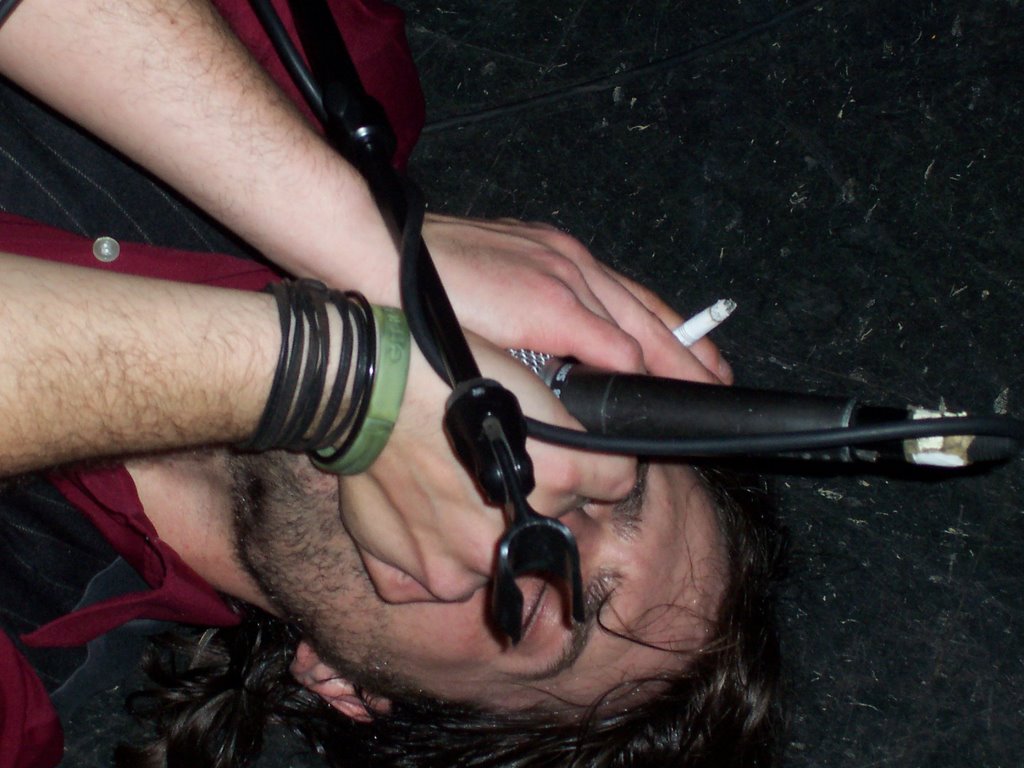
The music drops out a bit at this point. A few in the crowd think this might be the end of the song. If you don’t know the tune, it might sound like the song has ended. A bit anti-climactic, I suppose, but it could work. Remaining firmly entrenched at the microphone, Serge makes it clear however, that the song is not over. There is more, the tale must have a denouement. He downs the rest of his whiskey, turns sharply on his heel and lofts his tumbler, which now only holds ice, through the air, onto the stage, where it cracks into a dozen pieces and hundreds of microscopic bits.

He broke the dish. He broke the fucking dish. How do you get more perfectly theatric than that? Okay, it's a glass, but who the hell cares? It is a moment that I ‘m certain has never happened before, because he played it so perfectly unaffected that it couldn’t have been rehearsed. But perhaps I’m wrong, because if executed it right, Serge could use this move every night in a different city and it would be one of the most potent bits of stage business ever used in a rock show. A sparkling, razor-edged image of everyman rebellion that cuts right into us, before he sings:

I awoke to the sound of Monique calling out from her nightmarish side of our bed
My wrists were all flesh there were no signs of cuts
As I reached out to touch her sweet head
As the sweat on her face found a new resting place
On the tip of my fingers I leaned
Into her ear and told her no fear
We're just having the same awful dream.

And the door gets kicked in. There is nothing left to say so the harmonica blows again. But this time, every bitter taste and disappointment the song lamented gets exhaled through those tuned holes and turned into sweet release. And the drums wash over themselves in the rhythm that doesn’t stop, not even for a nightmare. And Frontman watches his silly older brother writhe on the floor, but wouldn’t quit strumming his guitar for that sibling if you made him the goddamned King of Prussia.

As the song reached its last throes and fits of life, the crowd swelled around the splayed singer, trying to get closer to this shambolic (there, I said it) wildman, and also checking to make sure that he wasn’t dying himself. With a hand from one of the few youthful longhairs in the crowd, he popped up and dragged his mic back to the stage. And again, the act was complete. On this night, there was an even more rousing encore, replete with Willie Nelson and Replacements covers that shook the house like so many New Madrid faults. But “The Dishwasher” still tied it all together. If they hadn’t played this song, it still would have been a great show that rocked the town and gown. But with it, the show went far beyond great live music. A simple, well-timed toss of a glass, combined with a sense that the audience was being led somewhere special, a back way through a kitchen door like Ray Liotta, but nothing so crass as a mobbed-up nightclub. Rather, some steam filled world where the people who carry the burdens of quotidian life go to spread their souls out in a magical hot-springs. A hidden place where they achieve some momentary respite from the knife-against-the-wrist inducing banalities to which they will have to return. It would not surprise me if some in the audience harkened back to this piece of art when they watched the Ecuadorian busboy schlep fifty pound tubs through the dining room of their local Chili’s. Those who witnessed Marah on Feb. 16th will, at the least, hold the performers at the next rock concert they attend to a higher standard. Subconsciously or not, the quality of Marah live, specifically “The Dishwasher’s Dream” raised the bar for what they expect and desire from a live performance.

When introducing the band, Dave Bielanko frequently praises bandmates Adam Garbinski and Dave Peterson with the acclamation, “These guys save Rock ‘n’ Roll every night.” For a long time, I used to recoil when I heard utterances about someone saving rock and roll or, about rock and roll being dead. Ever since I played air guitar as a four year old, I have firmly believed that the genre was alive and kicking. But hearing the younger Bielanko’s specific phrasing, I have reconsidered my stance. Live rock and roll, live performance in general, does need saving. But not by any half-assed record company Rock-essiah, and not for thirty days in June at your local Verizon Coors Chase Wireless Music Dome-a-lladium-phatheater. Rock and roll needs saving, like the man says, every night. No matter how many tapers have their DATs running, a live rock show dies when it is over. That one show and its soul ascend to the stars never to be seen in earthly corpus again. And so, a true performing artist must take up that mantle of resurrector and bring their songs, their play, their dance back to life the next night, and the next and the next...

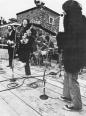
Call me a fossil, a luddite, a hopeless optimist, or anything you like, but despite our current insatiable appetite for technologically captured art and culture that can be stored, burned, canned, ripped and pro-tooled, I believe live performance will live forever. The evanescent experience of watching a person create art in a moment has fascinated us for millennia, and outlived dozens of civilizations. Humans crave the spark of communication that occurs when another person steps out into that numinous pool of light and opens their mouth to speak, or leans over in Arabesque, or counts down the opening number. To share a creation that will, in truth, never exist again with a group of others closely surrounding us is magical, spellbinding. The caves at Lascaux are spectacular, but they are Platonic shadows of the live spectacle that those prehistoric Frenchmen witnessed out their troglodyte doors. Likewise, no matter how many “Sgt. Peppers” are pressed into wax or turned into bytes, those who saw John, Paul, Ringo and George on top of the Apple Records building witnessed a human interaction so intense, I’m not sure rock has matched it since. But those Liverpudlians had to stay away from the stage for years to have that kind of impact. Now, don't let this twist your wig. I'm certainly not venturing close to the territory of "Marah is better than The Beatles." That would just be silly and wrong. But when it comes to stage performance, if the whole of live rock and roll were to have been left to The Beatles, it might indeed, have died. I’m far more comfortable leaving something that important in the hands of a band of brothers who pack up every tool they own and build a new cathedral every night. And when they’ve set the keystone and hung the bells in the tower, they rear back and knock the whole damn thing down with one perfect song. And so it goes, night after night, live and in the flesh, the boys in Marah step onto the stage and into the footlights and save rock and roll.