Some of my favorite humans are Humanists. Maybe that term is too vague or loaded, but I think I'll stick with it.
That is, the people I find most interesting, insightful, and imitable, are primarily interested in people. Particularly when it comes to my favorite songwriters. Whether they are truly Humanists who reject other more dogmatic theological doctrine, or just find humans more interesting and valuable than imaginary wizards in the sky, I don't know. (Not that sky wizards aren't cool, they just don't show up 'round here enough for my tastes. Every two-thousand years is less frequent than the elusive McRib, for goodness sake).
However, these same Humanistic songwriters who seem genuinely concerned with the plight of their fellow man and worry when injustice is done, also like to hold a giant magnifying glass up to the sores of humanity. They don't shy away from sticking their fingers into abscesses or turning on the bright lights to see the boils and scabies even better.
Dylan took this tact often, with songs like "Lonsome Death of Hattie Carrol," "The Death of Emmit Till," and plenty of others. Westerberg worried mightily about the plight gender-queer kids in tight pants with wallet-chains long-ago, many years before Pete Wentz married the prom-queen. Fiona Apple might be a co-dependent bore in real life, but in her songs, she will punch you in the dick if you mess-over another girl. Eddie Vedder used to wear a hair-shirt for ever bete-noir teenager in the world. Rhett Miller, even though he married a super-model, has to work very hard to write anyting but songs of romantic lament, sad anthems for every skinny dork in Texas who never got the girl.
Ike Reilly - "I Don't Want What You've Got (Goin' On)," Sparkle in the Finish.
Ike Reilly falls in with this very loose assemblage of songwriters. He is most assuredly disturbed by the callousness with which the modern world treats his fellow man. But goshdarn if he doesn't find his fellow man in equal parts, pathetic, annoying, disgusting and despicable. If there were another form of life on Earth with whom he could cavort, converse and copulate, he would undoubtedly prefer them to human beings. But since there is not, he's thrown his lot in with the Adams and Eves.
A glance at his album titles lets you know he's a bit jaded and not always hopeful when it comes to his brethren. Salesmen and Racists? Pick one, or maybe you're both. Junkie Faithful. Opiate of the masses or Church of Burroughs. I don't know which one makes me less nauseated. Posion the Hit Parade. Music biz got you down, Ike?
That said, he is the most underrated purveyor of cynical folk-rap this side of St. Bob. His songs make you want to shout, dance, lock arms and march, break bottles and fight, and then go back to the bar to tell each other stories as you bleed on the beer-soaked floor. See him live.
Thursday, April 22, 2010
Wednesday, April 21, 2010
Underrated H cont'd. - Holes in the Backdrop of the Memory
The most satisfying aspect of this exercise is not shilling for my favorite bands, but looking back through my music catalog and finding the bands that I, myself, never paid enough attention to. Both of these two fall into that category.
Homunculus - "Cornelia," The Pulse of Directed Devotion.
I first got romantic with my wife at a Homunculus show. We didn't neck in the corner of the club or anything so classless. We simply danced. Not even that junior high dry-hump kind of dancing. More like late '80s Solid Gold hip-couple-on-the-upstairs-scaffolding dance. It was sexy, I'm sure.
Homunculus was composed of IU dudes who all had wildly eclectic tastes in music, but actually found a way to create a somewhat focused sound guided by a mission statement that went something like "The Funky Meters meets a Beatles Fan Club, with a little Jam Bandiness thrown in."
They weren't afraid to drop it on the one and at the same time loved syrupy sweet lyrics and choruses. Their overall visual aesthetic was remarkably consistent, with every band member wearing a suit onstage. I loved them and went to every show at the Bluebird in Bloomington that I could make it to. They were exceptional live--funky, sweaty fun with lots of this going on.
And like friends from college with whom we've lost touch, I lost touch with Homunculus after I left Bloomington. The singer from the song above and below left the band around the time I was finishing at IU. I saw the band a couple of times in New York, but not nearly with the frequency I did in Southern Indiana.
Homunculus recorded one more album and toured extensively in the early Aughts, but eventually broke up.
My wife and I danced to one of their songs at our wedding.
Their first two records are highly underrated.
Cornelia
Hot Hot Heat - "Goodnight, Goodnight," - Elevator.
Talk about textbook underrated. I don't even own a complete album from these guys, but I would put two of their songs, "Bandages" and "Goodnight, Goodnight," in my top 100 singles of the 2000's.
They are best described as post-Punk post-Ska post-alternative Alternative-Ska-Punk. That's some fine genre murder, right there.
My brother-in-law even has a fleeting cameo in one of their videos.
Every time I hear their songs I think about how much more I ought to listen to them. I never do.
This song should make you happy and dancey and think about a time when you kicked some dude/chick to the curb and felt good about it.
Homunculus - "Cornelia," The Pulse of Directed Devotion.
I first got romantic with my wife at a Homunculus show. We didn't neck in the corner of the club or anything so classless. We simply danced. Not even that junior high dry-hump kind of dancing. More like late '80s Solid Gold hip-couple-on-the-upstairs-scaffolding dance. It was sexy, I'm sure.Homunculus was composed of IU dudes who all had wildly eclectic tastes in music, but actually found a way to create a somewhat focused sound guided by a mission statement that went something like "The Funky Meters meets a Beatles Fan Club, with a little Jam Bandiness thrown in."
They weren't afraid to drop it on the one and at the same time loved syrupy sweet lyrics and choruses. Their overall visual aesthetic was remarkably consistent, with every band member wearing a suit onstage. I loved them and went to every show at the Bluebird in Bloomington that I could make it to. They were exceptional live--funky, sweaty fun with lots of this going on.
And like friends from college with whom we've lost touch, I lost touch with Homunculus after I left Bloomington. The singer from the song above and below left the band around the time I was finishing at IU. I saw the band a couple of times in New York, but not nearly with the frequency I did in Southern Indiana.
Homunculus recorded one more album and toured extensively in the early Aughts, but eventually broke up.
My wife and I danced to one of their songs at our wedding.
Their first two records are highly underrated.
Cornelia
Hot Hot Heat - "Goodnight, Goodnight," - Elevator.
Talk about textbook underrated. I don't even own a complete album from these guys, but I would put two of their songs, "Bandages" and "Goodnight, Goodnight," in my top 100 singles of the 2000's.
They are best described as post-Punk post-Ska post-alternative Alternative-Ska-Punk. That's some fine genre murder, right there.
My brother-in-law even has a fleeting cameo in one of their videos.
Every time I hear their songs I think about how much more I ought to listen to them. I never do.
This song should make you happy and dancey and think about a time when you kicked some dude/chick to the curb and felt good about it.
Labels:
Bloomington,
Homunculus,
Hot Hot Heat,
Underrated H
Sunday, April 18, 2010
Underrated H - We're gonna start it with a positive jam. Hold Steady.

The Hold Steady - "Your Little Hoodrat Friend," Separation Sunday; "Stuck Between Stations," Boys and Girls in America; "Sequestered In Memphis," Stay Positive
"You either love them or hate them." How many times have fans or lazy critics uttered this phrase when recommending a band? How many angels can dance on the head of a pin? The problem is, ten times out of nine, the band is not very good at all. The people who love them are their friends and family. The people who hate them are everybody else. Don't tell me your brother-in-law's noisecore project with three turntablists and a Theremin player is a "love it or hate it" proposition. Unless I am related to the people on stage, that is a "hate it or drink arsenic" proposition.
So, obviously this is the point where I say, "Love it or hate it is a myth, EXCEPT FOR THESE GUYS..." Well, I'm not gonna do that.
In the first place 8000 other Monday Morning Christgaus have already said it. And the second-to-last thing I want to be is trite. (The absolutely last thing I want to be is from New Jersey.)
My thesis is, therefore, rather muddled:
I hereby proclaim that you will NOT find yourself tied to a binary choice between adulation and antipathy when you listen to The Hold Steady.
You might think they sound kind of weird and interesting, but aren't your cup of tea. Perhaps you'll find their anthemic rock and roll reminiscent of early era Bruce/E-Street records, mixed with a more punk rock aesthetic, as so many others have described their sound. Maybe lead singer Craig Finn's tales of burnouts and barflies will take hold of you like Dickens' serials took hold of the readers in the nineteenth century. Maybe his voice will make you want to crawl up the walls and stuff cactus in your ears just to make it stop.
And so you have options. You don't have fall in love with this band that simultaneously venerates and tears down the Twin Cities like Dr. Johnson did with London. You don't have to want set the disc on fire and douse it with urine, either.
So why are they underrated? After all, websites like Pitchfork and numerous other critics love these guys. The fact that Finn keeps a cast of characters weaving in and out of all four Hold Steady records fascinates some, mainly because virtually no other modern songwriters use this device. He also creates a lexicon that initially seems limited and repetitive, overusing words like positive, party and killer. He juxtaposes elementary words-- cold, hot; soft, hard--sounding like a poet who lost his thesaurus on first listen. But if one follows the entire through-line of the narrative from Almost Killed Me to Stay Positive all of the words and figurative language that appeared simplistic at first, take on immense poetic significance. He unpacks every double meaning and injects a sense of risk into the simplest turn of phrase. And Finn makes no bones about shooting to be a 21st century Kerouac. The album "Boys and Girls in America" grew out of Finn's belief that he could write a whole record about just one of Sal Paradise's lines in On the Road.
But, again, none of this points to being underrated. And maybe they aren't. But that whole bullshit about love/hate that gets lumped on these guys, and has been since they broke up Lifter Puller and formed The Hold Steady, hasn't allowed for any sort of accurate gauge of how many people might actually enjoy this band. Hipsters and music geeks superpraise THS, wanting to be counted in the Love Them crowd, so their fervor (count me in) can't be trusted. And the material might be too dense and Finn's vocals too idiosyncratic for casual listeners to sift through when they've already been prejudiced with the love/hate preface by whoever gave them the record.
Personally, I think that twenty-years from now, I will be glad that I knew who these guys were. For everyone who doesn't know who they are, give them a try. You might kinda, sorta, halfway enjoy them a bit. Or you might not.
Sunday, April 04, 2010
How A Resurrection Really Feels
It really hasn't been that long since a team from Indiana has been in the NCAA championship game. In 2002, the IU Hoosiers lost to Maryland in an improbable post-Knight run to the Final Four. But since then, IU has spiraled into sanction-laden obscurity. Purdue, despite always performing well in the Big Ten, has classically under-achieved in the NCAA's. Looking past college basketball, the Pacers have gone from lovable, scrappy contenders to a bunch of uninspired millionaires who continue to play with the shadow of the 2004 brawl in Detroit hanging over them.
So while it hasn't been long at all since an Indiana team has been successful at basketball, it feels like the lid has been lifted on an old hope chest and all the musty, old blankets have been cleaned with fresh air and sunlight. Kelvin Sampson, Gene Keady's sad final seasons of an otherwise hall-of-fame career, the refs in the Butler v. Florida game, Ron Artest and Jermaine O'Neal, I can go flick jumpshots in the driveway without thinking about any of that.
I'll get back to my regular programming of navel-gazing and trying to convince other people that my tastes in music are superior to the public at large pretty soon. But right now, I'm savoring the way basketball tastes for the first time in nearly a decade.
I have no illusions about some return to a more "pure" form of college basketball. Butler is not a babe-in-the-woods program who made it all the way to the big game by wishing on butterfly wings and sprinkling pixie dust on the court. During this recent window of time when other programs in the state were struggling, they went and ferociously recruited in-state talent. They pursued and signed players from out of state who fit their program and who were passed up by bigger D-1 programs, so they play with a chip on their shoulder. They are all gifted athletes who play great defense and battle anyone who steps on their court.(And if Hayward and Mack don't declare after their junior year, it will only be because they are thinking with their hearts instead of their retirement funds. Honestly, if I had my druthers, I'd probably eliminate athletic scholarships altogether and tell David Stern to stick his NBA age limit where the pampers is.) But college basketball is a BIG money endeavor and no one, not even Butler and Brad Stevens, no matter how much they may be exemplars of how to do the whole "student-athlete" thing right, comes out of the NCAA wringer totally clean.
That said, I will have no second thoughts tomorrow about shredding my vocal chords yelling for Butler as the Bulldogs attempt to knock off Duke andKaiser K Coach K. I will be shooting as many hoops as I can before then. And hopefully, at around 11:45 PM, I'll be singing along with a really cheesy song that was first broadcast after an Indiana team won the championship, listening to my neighbors cheer and scream into the night sky.
So while it hasn't been long at all since an Indiana team has been successful at basketball, it feels like the lid has been lifted on an old hope chest and all the musty, old blankets have been cleaned with fresh air and sunlight. Kelvin Sampson, Gene Keady's sad final seasons of an otherwise hall-of-fame career, the refs in the Butler v. Florida game, Ron Artest and Jermaine O'Neal, I can go flick jumpshots in the driveway without thinking about any of that.
I'll get back to my regular programming of navel-gazing and trying to convince other people that my tastes in music are superior to the public at large pretty soon. But right now, I'm savoring the way basketball tastes for the first time in nearly a decade.
I have no illusions about some return to a more "pure" form of college basketball. Butler is not a babe-in-the-woods program who made it all the way to the big game by wishing on butterfly wings and sprinkling pixie dust on the court. During this recent window of time when other programs in the state were struggling, they went and ferociously recruited in-state talent. They pursued and signed players from out of state who fit their program and who were passed up by bigger D-1 programs, so they play with a chip on their shoulder. They are all gifted athletes who play great defense and battle anyone who steps on their court.(And if Hayward and Mack don't declare after their junior year, it will only be because they are thinking with their hearts instead of their retirement funds. Honestly, if I had my druthers, I'd probably eliminate athletic scholarships altogether and tell David Stern to stick his NBA age limit where the pampers is.) But college basketball is a BIG money endeavor and no one, not even Butler and Brad Stevens, no matter how much they may be exemplars of how to do the whole "student-athlete" thing right, comes out of the NCAA wringer totally clean.
That said, I will have no second thoughts tomorrow about shredding my vocal chords yelling for Butler as the Bulldogs attempt to knock off Duke and
Tuesday, March 30, 2010
Winning or Not Losing
Butler won. In spite of, or as a result of my Swiftian exhortations? I don't know. All I know is that my son, keen little pitcher with big ears that he is, when I asked what he thought about Butler winning, said, "I'm speechless. I don't know what to say." He heard this phrase from someone at my parents' house, either my mother or Bob Proctor. Nevertheless, he knew that we were all hooting and hollering about something rather unexpected and unprecedented and he brought out the line on cue. I almost swerved off the road.
In five days, Butler will play a semi-final game against Michigan State in Lucas Oil Stadium, Indianapolis, Indiana. And here, in the seemingly wonderful serendipity of the location, lies the only impediment to their winning the whole dang thing. It is not their lack of relative size compared to other teams. It is not that MSU and West Virginia are spectacular rebounding teams, or that Duke has three NBA players in its starting lineup. The home city advantage is actually a very sharp, double-edged sword for these Bulldogs, because no matter what the result this weekend, these Bulldogs cannot lose.
They may get beaten by twenty-points on the scoreboard, but in the end they are winners. Gordon Hayward, Shelvin Mack, Ron Nored, Matt Howard, Willie Veasly, and all their teammates will be conquering heroes whether they win or lose. In the eyes of Indiana residents and the country at-large, they are the underdogs who made it to the Final Four. Everything else is gravy on the taters. So Brad Stevens' lone challenge is not game-planning for the Spartans and crazy-good coach Tom Izzo, rather it is to get his team to fear contentedness and satisfaction.
Even the most competitive sumbiches could get pretty swelled up and slow if they came back home at 4 in the morning to screaming, delirious crowds. And if they are anything, these Bulldogs are competitive. But fighting against the insidious mindset that they have "already won" has to be tough for player and coach alike.
Forgive me, I could ramble on about these less-than-concrete ideas for too long. My hope is this, Butler goes out looking for blood. Elbows to the neck, heel-kicks when defending in the low blocks, rabbit punches to the kidneys. No holds barred. Use every flipping foul they give you and get ready to take a punch and shoot the technical afterwords. Butler may be a feel-good story but their opponents will give them no quarter. They should be ready to do the same.
Go out and try to win, because they already can't lose.
Labels:
Brad Stevens,
Butler,
Butler Bulldogs,
Final Four,
Home Court Advantage,
Lucas Oil
Wednesday, March 24, 2010
Underrated H - Hinkle Huskers

Please, whatever you do, you faithful readers out there in the interlands, do NOT root for Butler. If you are not a Butler Alum or a resident of the Butler-Tarkington/MKNA neighborhoods of Indianapolis, do not make this team the spunky underdog you are going to pull for. If you have never been to Hinkle Fieldhouse to see a game, don't know who Barry Collier is, haven't heard of A.J. Graves, Mike Green, Rylan Hainje, Joel Cornette, Darnell Archey, Jon Neuhouser, Jermaine Guice, or Darin Archbold, STAY THE EFF AWAY FROM THIS TEAM BECAUSE YOU WILL RUIN THEM.
I say this only kind of jokingly, because for the last twenty years Butler has defined the rise of the Mid-Major in college basketball, and they've done so, in part, by always being slightly underrated. In the early 90's, I went to way too many Butler games when I should have been doing Chemistry homework or trying to get dates with girls. However, this wasn't foolish escapism. The fact was that Butler was putting high-caliber basketball on display every time they hit the floor of hallowed Hinkle. It wasn't until 1997 that they finally made an NCAA tournament for the first time since old man Hinkle was at the helm; they were a casualty of an exceptionally competitive conference and conference tourney in the MCC and Horizon. However, I remember the level of play exhibited from 1991-1996 and it was indistinguishable from some of the middle rung Big Ten and Big East schools. And of course, within a few years of their first NCAA shot, Butler made a run at knocking off highly-ranked Florida, a feat they would repeat in 2007 when they nearly derailed the Gators who were on their way to a second consecutive championship.
Despite this success, Butler still doesn't sell out every home game. And they play their home games in the stadium where Hoosiers was filmed for jeebus' sake. Somehow this all helps them. Butler rosters are usually composed of a bunch of kids who wouldn't start on ACC, SEC or Big Ten teams because they aren't quite selfish or flashy enough. AJ Graves would've gotten clean-up minutes at IU. Mike Green transferred from a small Philadelphia school and when he got to Butler played like he was trying destroy every "big-time" program who passed on him. He made every player on Butler's team better and played harder and stronger than guys a foot taller than him. Darnell Archey came to Butler and showed everyone else in basketball what consistency and dedication really was. He hit 85 free-throws in a row at one point in the season. And still, the bleachers in the top of the Fieldhouse aren't always full.
During a heated game against the Evansville Aces in 1991, I was sitting above the Butler goal watching the action unfold. The game was close and the star players, Parrish Casebier for Evansville and Darin Archbold for Butler, were going at it, hammer and tongs. On this particular play, Casebier, wearing the metaphorical black hat, wound up guarding Archbold. Archbold had a killer jumper and a nose for the open space where shots develop--a skill best honed, not through practice with coaches and teammates, but by spending hour upon hour in open gyms with aggressive middle-aged guys who hip-check you every time you try to curl around a screen. You don't call fouls because they'll just call you a pussy under their breath and hit you with a sweaty hamboned elbow in the chest the next time down. Instead, you find the space and you stick the jumper right in their face and then swat the shit out of their lay-up when they attempt to exact some ill-advised revenge.
But I digress. Casebier saved his best stuff for Butler. He was a slick kid, with a bowling ball physique and a nasty attitude. He would talk trash all game and light up anybody who gave him too much room. He would also defend with his beer-belly, which worked because he was still faster than everyone else, despite his layer of insulation. The memory I have of this moment is short and sweet and quintessential Butler basketball. Archbold took a pass and dribbled around a high screen, Casebier switched to him and stuck his tummy into Archbold's hip. Archbold drove toward the baseline and elevated about eight feet from the hoop, with Casebier riding him the whole time, and cooly called out "backboard" as he banked in his shot off the glass while the ref blew his whistle.
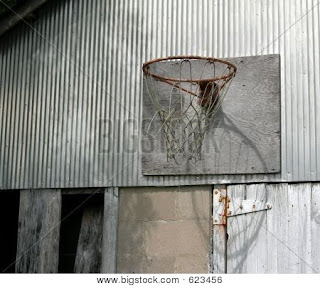
In that "backboard," I heard the voice of every kid who I ever played against in my backyard. And Butler has always been made up of the best backyard players. The guys who throw no-look bounce passes, not because it makes them look good, but because their teammates wouldn't dare miss the lay-up after such a great pass. The guys who learned how to bank it from eighteen feet because the rim was just tight enough that a slightly off-center shot would thunk off the iron, as opposed to trickling through as the shot would on a more forgiving, professional rim.
Butler has always been in my backyard. And I feel guilty for not going to enough games, even though I've been to quite a few. So I know the rest of my friends, neighbors, and peers, particularly those who profess to be Hoosiers and basketball fans, must feel extra dopey every March when the Bulldogs make their annual stand against the Goliaths of the basketball world. And therefore, I once again plead with you: do not make this Saturday the night you turn Butler into your prize pony instead of your rented mule. They have been underrated for going on twenty years now. And it works for them. They thrive on it. The minute all us yahoos who didn't really pay attention to which one was Howard and which one was Hayward start cheering and dipping chips in Butler's honor, they lose that advantage. So go cut your grass or plant your tomatoes. But don't play pretend Butler fan.
Save that for next Saturday...

Sunday, March 21, 2010
Underrated G Cont'd. - Cold Beverages and Buffaloes
I'm not sure either of these artists are overrated. So much for being committed to the material. However, when I did my initial assessment, I included them and so I will give them the benefit of the doubt. Each of them reached a kind of career popularity apex where they were perfectly "rated" in terms of how many people were listening to them and singing along, refer to the Klosterman Index here. The Avett Brothers have reached that point RIGHT NOW.
G. Love and Special Sauce - "Stepping Stones," Yeah, It's That Easy
G. Love peaked early in his career. Two songs of his persist in popularity, played regularly at frat parties and keggers across the country, they are both standards in the drunken hook-up hymnal. "Cold Beverage" and "Baby's Got Sauce" from his first album G. Love and Special Sauce are still stand-by's for Delta-Chi's looking to get their white boy blooz on. G. Love, (also known as Garrett Dutton) with his Presley-esque coiffure and his absurd, over-the-top, urbanized Philly patois, never quite achieved the level of sales success these first two singles hinted at. The highly derivative blues and R&B he played became much more marketable when performed by an actual black man (Ben Harper) or by a more neutral hippy-dippy white voice (Jack Johson). Nevertheless, G. Love was a fearless dude when it came to wearing his tastes and influences on his sleeve. His 1997 release Yeah, It's That Easy struggled to encompass all of the myriad musical influences he wanted to acknowledge, a symptom that verged into borderline-schizophrenia on later records. However, on a few tracks G. Love absolutely hits his mark hearkening back to the best of '60s Philly soul while adding a modern twist. This is how all high school dances would sound if Jim Crow had never happened.

Grant Lee Phillips - "Wish I Knew," Virginia Creeper
*Warning - I'm going to use the term alt.country a lot here. It's just easier than anything else and people kind of know what it means, I'll throw in a few synonyms and neologisms for fun, too.
It's hard to imagine a time when Jeff Tweedy wasn't the foremost practitioner of bent Americana. After Uncle Tupelo broke apart, Farrar and Tweedy quickly formed new outfits, but except for the hit single "Drown," neither Wilco or Son Volt seemed like they would set the alt.country world on fire in the way they did with tunes like "Whiskey Bottle" and "Graveyard Shift." A.M. was good, Trace was good, but I wasn't sure they were great. (In retrospect both these records are absolutely perfect middle steps in the careers of two of the best songwriters of the last twenty-five years.) Late 1993 into 1994 it wasn't clear if the No Depression-era of country-influenced rock was going to continue.
In walks Grant-Lee Buffalo and alt.country became something altogether different. GLB continued, where Tupelo had begun, re-inventing what American rock and roll sounded like. But this re-invention of country bore signs of influence more far-flung than the Carter Family and Nashville Skyline Dylan. There were hints of 80's New Wave mixed with the banjoes and dobros. It had the fuzzy impertinence of Neil Young with the queer take on rock and roll that made R.E.M. so intriguing. In fact, their first record was called Fuzzy. And within a year of that album, they released Mighty Joe Moon. They toured with Pearl Jam when nobody was bigger than Pearl Jam.
All of this had to do with Grant-Lee Phillips' songwriting and his vocals. His tone was precise and he commanded a perfect Nashville vibrato, but he was able to be vocally eccentric and odd when the moment called for it.
In 1996 Wilco released Being There and Beck released Odelay and alt.country and cow.hop's kings were crowned. By 1999 Grant-Lee Buffalo had disbanded and Phillips was playing and recording as a solo artist, as he has been now for the last decade. And he is still damn good at it. Perhaps he's not the greatest alt.country figure of our time, but he was very important for a moment. And his albums from the 2000's have some real gems. Great American songwriter and definitely underrated.
G. Love and Special Sauce - "Stepping Stones," Yeah, It's That EasyG. Love peaked early in his career. Two songs of his persist in popularity, played regularly at frat parties and keggers across the country, they are both standards in the drunken hook-up hymnal. "Cold Beverage" and "Baby's Got Sauce" from his first album G. Love and Special Sauce are still stand-by's for Delta-Chi's looking to get their white boy blooz on. G. Love, (also known as Garrett Dutton) with his Presley-esque coiffure and his absurd, over-the-top, urbanized Philly patois, never quite achieved the level of sales success these first two singles hinted at. The highly derivative blues and R&B he played became much more marketable when performed by an actual black man (Ben Harper) or by a more neutral hippy-dippy white voice (Jack Johson). Nevertheless, G. Love was a fearless dude when it came to wearing his tastes and influences on his sleeve. His 1997 release Yeah, It's That Easy struggled to encompass all of the myriad musical influences he wanted to acknowledge, a symptom that verged into borderline-schizophrenia on later records. However, on a few tracks G. Love absolutely hits his mark hearkening back to the best of '60s Philly soul while adding a modern twist. This is how all high school dances would sound if Jim Crow had never happened.

Grant Lee Phillips - "Wish I Knew," Virginia Creeper
*Warning - I'm going to use the term alt.country a lot here. It's just easier than anything else and people kind of know what it means, I'll throw in a few synonyms and neologisms for fun, too.
It's hard to imagine a time when Jeff Tweedy wasn't the foremost practitioner of bent Americana. After Uncle Tupelo broke apart, Farrar and Tweedy quickly formed new outfits, but except for the hit single "Drown," neither Wilco or Son Volt seemed like they would set the alt.country world on fire in the way they did with tunes like "Whiskey Bottle" and "Graveyard Shift." A.M. was good, Trace was good, but I wasn't sure they were great. (In retrospect both these records are absolutely perfect middle steps in the careers of two of the best songwriters of the last twenty-five years.) Late 1993 into 1994 it wasn't clear if the No Depression-era of country-influenced rock was going to continue.
In walks Grant-Lee Buffalo and alt.country became something altogether different. GLB continued, where Tupelo had begun, re-inventing what American rock and roll sounded like. But this re-invention of country bore signs of influence more far-flung than the Carter Family and Nashville Skyline Dylan. There were hints of 80's New Wave mixed with the banjoes and dobros. It had the fuzzy impertinence of Neil Young with the queer take on rock and roll that made R.E.M. so intriguing. In fact, their first record was called Fuzzy. And within a year of that album, they released Mighty Joe Moon. They toured with Pearl Jam when nobody was bigger than Pearl Jam.
All of this had to do with Grant-Lee Phillips' songwriting and his vocals. His tone was precise and he commanded a perfect Nashville vibrato, but he was able to be vocally eccentric and odd when the moment called for it.
In 1996 Wilco released Being There and Beck released Odelay and alt.country and cow.hop's kings were crowned. By 1999 Grant-Lee Buffalo had disbanded and Phillips was playing and recording as a solo artist, as he has been now for the last decade. And he is still damn good at it. Perhaps he's not the greatest alt.country figure of our time, but he was very important for a moment. And his albums from the 2000's have some real gems. Great American songwriter and definitely underrated.
Wish I Knew - Grant Lee Philli...
As a post script, I wish to acknowledge and thank any of yous who are "following" this blog. I didn't even know that function existed until a month ago. So, thanks. You are very kind.
Subscribe to:
Posts (Atom)


